
The In-House Lab Behind Every Export Batch
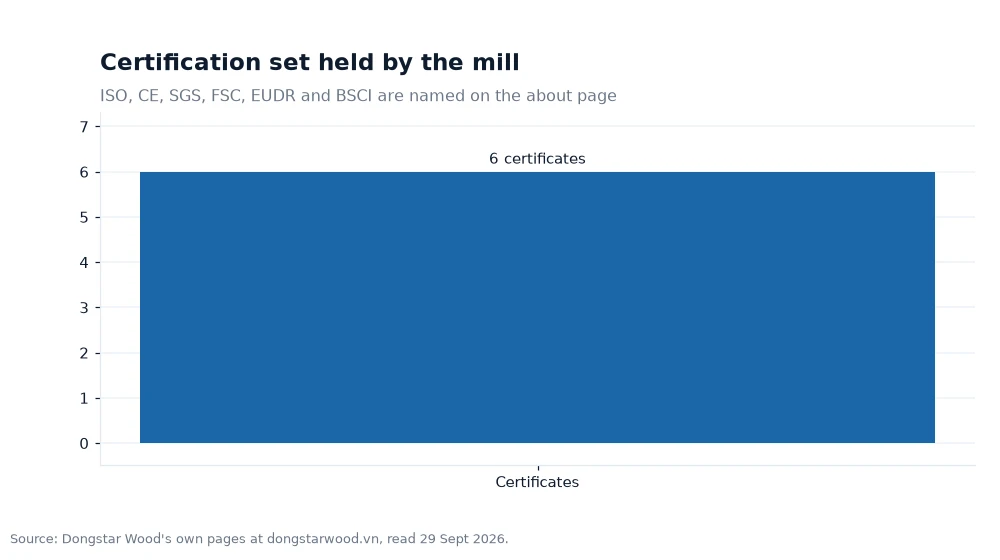
An export batch is only as good as the last test that passed it. Dongstar Wood runs in-house lab testing from raw materials to export batch, names six certifications — ISO, CE, SGS, FSC, EUDR and BSCI — and applies batch checks such as panel thickness consistency and core construction inspection before a container is released.
Key takeaways
- In-house lab testing covers the chain from raw materials to export batch.
- Six certifications are named: ISO, CE, SGS, FSC, EUDR and BSCI.
- Batch inspection items include panel thickness consistency and core construction integrity.
- Published capacity: 48,000 m² of factory space, 16+ automated lines and monthly supply above 100 × 40ft.
What in-house testing actually covers
The claim on the manufacturer's pages is a chain, not a spot check: in-house lab testing runs from raw materials to export batch. That means the veneer and the glue are tested before pressing, the pressed panel is tested for thickness, bond and construction, and the packed batch is checked before shipment. For a buyer, the value of the chain is traceability — when a panel fails on site, a mill that tested at each stage can point to the stage, and a mill that only tested the finished sheet cannot. The six certifications the company names — ISO, CE, SGS, FSC, EUDR and BSCI — are the frameworks those tests sit inside.
The chain is what makes the lab valuable. A mill that tests only the finished sheet catches defects after they have been pressed, glued and packed — the cost of a reject is not just the sheet but the production time and the packing material that went into it. A mill that tests the veneer before pressing, the bond after pressing and the batch before shipment catches the defect at the lowest-cost point in the chain. For the buyer, the chain also means that a quality claim can be traced to a stage: was it the veneer moisture, the glue ratio, the press temperature or the handling after pressing. That traceability is what separates an in-house lab from a third-party inspection that only sees the finished product.
The six certificates and what each one is for
The about page names six schemes, and each answers a different question. ISO covers the quality management system behind the process. CE marks the product's conformity for the European market. SGS is the third-party inspection and testing name buyers recognise on a certificate. FSC certifies the fibre source. EUDR is the deforestation due-diligence regime that now accompanies timber into Europe. BSCI is the social-compliance audit of the factory itself. A buyer who knows what each certificate is for can ask for the right document instead of a folder of logos.
The EUDR statement deserves special attention because it is the newest document in the set. The deforestation regulation requires a due-diligence statement that maps a consignment to its supply area, and the statement must be available before the timber enters the EU market. A mill that can produce this document — linking a batch of veneer to a specific plantation or forest concession — has already invested in the traceability that the regulation demands. A mill that cannot produce it will ask the buyer to provide the statement, which is a much harder position to work from. The about page names EUDR among the six schemes, which suggests the documentation exists; the buyer's next step is to ask for a sample before the first order is placed.
Batch checks before shipment
The ordinary batch checks are the ones that catch real problems: panel thickness consistency and core construction integrity. Thickness consistency matters because a joinery cutting list assumes a tolerance, and a batch that drifts outside it shows up as gaps and misaligned joints. Core construction integrity matters because a delaminated core is a panel that will fail in service however good the face looks. Both checks are named on the manufacturer's own pages, which means both can be written into a pre-shipment inspection request without inventing a test the mill does not run.
The practical value of writing the checks into the request is that the pre-shipment inspection then becomes a comparison between what was asked and what was done. A report that states panel thickness within tolerance and core construction passed is a report a buyer can show to a customs agent or an insurance underwriter, because it names the test and the result rather than a general assurance of quality. The two items — thickness consistency and core integrity — are the minimum; a buyer can add others, but these two are the ones that cover the most common failures in export-grade panels.
The factory the lab sits inside
The lab is only useful if the factory behind it can hold a specification. The manufacturer operates on a 48,000 m² site in Yen Bai Province, northern Vietnam, where a warehouse exceeding 3,000 m² and 16+ automated production lines support a stated monthly supply capacity above 100 × 40ft. The company was established in 2009 and describes 30+ years of manufacturing experience, and it states clients in over 170 countries and regions. A Vietnam Plywood export operation of that footprint has the volume to justify in-house testing — and the export routines to make the paperwork travel with the goods.
Reading a certificate request
The mistake buyers make is asking for "certificates" as a category. The useful request names the scheme, the product and the batch: the ISO certificate for the mill, the CE documentation for the panel, the FSC claim for the fibre, the EUDR due-diligence statement for the consignment, and the BSCI audit for the factory. Each document answers a different question at a different border, and a quotation that lists all six — as this manufacturer's pages do — tells the buyer the mill has thought about the paperwork before it was requested.
The request should also name the date of the document and the batch it covers. An ISO certificate issued three years ago may have lapsed; a CE document that covers a different product family does not apply to the panel being quoted. The specificity of the request is what turns a logo on a homepage into a document that clears customs. A buyer who asks for the certificate number, the date of issue and the product scope receives a file that an auditor can read, which is a different outcome from a folder of images that a website can display.
| Check | Published detail | What it protects |
|---|---|---|
| Lab testing | Raw materials to export batch | Traceability when a panel fails |
| Certifications | ISO, CE, SGS, FSC, EUDR, BSCI | The frameworks behind the tests |
| Thickness consistency | Named batch check | Joinery tolerances hold |
| Core construction | Named batch check | The panel survives service |
| Monthly capacity | Exceeding 100 × 40ft | The order fits the queue |
Worked example: capacity per production line
Example only, using the published figures. The mill publishes 48,000 m² of factory space and 16+ automated production lines, which works out at 48,000 ÷ 16 = 3,000 m² per line. A line that size can run a product family rather than switching constantly, which is the condition under which batch checks stay meaningful — the same crew, the same veneer, the same glue, the same press settings. On the supply side, 100 × 40ft per month ÷ 4 weeks = 25 containers a week, so a two-container trial order is roughly 2 ÷ 25 = 8% of one week's output.
Frequently asked questions
What does in-house lab testing cover?
The manufacturer describes testing that runs from raw materials to export batch — veneer and glue before pressing, the pressed panel for thickness and construction, and the packed batch before shipment. The chain gives a buyer traceability when something fails.
Which certifications does the mill name?
Six: ISO, CE, SGS, FSC, EUDR and BSCI. Each answers a different question — quality management, European conformity, third-party inspection, fibre source, deforestation due diligence and social compliance.
What checks are applied to each production batch?
The named batch inspection items are panel thickness consistency and core construction integrity. Both are ordinary checks in an export workflow, and both can be written into a pre-shipment inspection request.
From lab report to loaded container
The certificate that matters is the one that arrives with the batch, so request the documents by name before the container is packed. The film faced range and the birch panels pages show the specifications the lab is holding the mill to, and the about page ties the testing chain to the factory footprint behind it. Buyers who collect the paperwork at the quotation stage tend to clear their first container without a surprise.
The figures shown were compiled from the supplier's published pages checked 29 Sept 2026[1].