
Forty-Eight Hours After a Pool Switch: What the Wallet Should Show
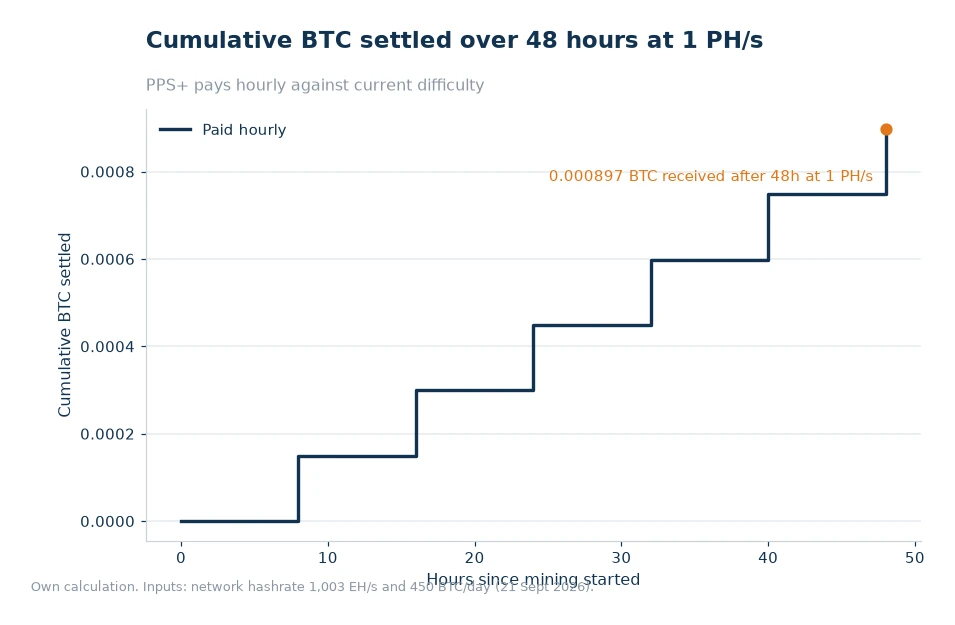
The two days after moving to a new pool are the only time the old and new arrangements can be compared cleanly. At 1 PH/s the new account should accumulate 0.00089721 BTC over 48 hours, or $75.99 at $84,692, arriving as 0.00014954 every eight hours. Write those numbers down before the switch, then check them rather than watching the balance and hoping.

Key takeaways
- Two days at 1 PH/s should add 0.00089721 BTC, worth $75.99 at $84,692.
- Checkpoints at 8, 24, 40 and 48 hours should read 0.00014954, 0.00044861, 0.00074768 and 0.00089721.
- A switch can expose a stale payout address or a worker name typo, so verify the first credit before leaving the old pool entirely.
- Settlement timing differs between schemes, so compare like with like before deciding the move was a mistake.
The first hours after a switch are a data-collection window
Moving pools changes three things at once: the settlement scheme, the payout cadence and the account that receives the coins. If the move disappoints, it is hard to say which of the three caused it. Two days of careful readings narrows that down, because the hashrate is unchanged and the network total is unchanged. Only the arrangement moved.
The window is also when configuration errors surface. A worker name that does not match, a payout address copied from an old note, a secondary coin that was not enabled: all of these produce partial or missing credits, and all are easier to fix before the old pool's grace period ends. Keep the previous account open and funded until the new one has produced its first full day.
What forty-eight hours can and cannot prove
Two days is long enough to confirm that credits arrive at the expected rate and short enough to be worth doing before committing. It is not long enough to judge the pool's luck, and it is not long enough to see a difficulty adjustment work through, since adjustments are roughly two weeks apart. Treat the window as a plumbing test rather than a performance review.
Write the expected numbers down before the switch, including the checkpoints, so the comparison is against a figure chosen in advance rather than a figure invented afterwards. A prediction made beforehand is a test; a target set after the result is a rationalisation, and the difference shows up the moment the pool underperforms and nobody can agree on what should have happened.
That distinction keeps the reading honest. A new pool that produces exactly the expected amount has passed the plumbing test; it has not demonstrated anything about the next six months. A pool that produces 10% less has failed the test and needs investigation, because at constant hashrate and difficulty there is no legitimate reason for a shortfall of that size under PPS+.
Matching the wallet to the old pool's rhythm
Different schemes produce different shapes, and the shape is the first thing to compare. PPS+ pays hourly against current difficulty, so the new balance should rise in small, even steps. PPLNS pays after six confirmations and shares each block across the last five difficulty rounds, so the balance rises in lumps whose size and spacing vary. A miner who expects hourly steps from a PPLNS pool will think something is broken on the first quiet afternoon.
Open the ViaBTC Crypto Wallet side by side with the pool dashboard for the first two days, because the two views answer different questions. The dashboard says what hashrate was credited to the account; the wallet says what actually arrived. A gap between them is the earliest sign of an address problem, and it is much easier to spot with both tabs open than from memory.
The wallet itself does not impose a rhythm; it records what arrives. What it does give you is a single ledger where credits from the new pool appear beside any balance left from the old one, which makes the comparison straightforward. The multi-currency wallet also holds balances in other coins, useful if the old pool paid in a different asset and you have not yet decided whether to convert.
A first-hour checklist that prevents most shortfalls
Four items are worth confirming before the first credit is expected. The payout address must match the one you intend to use, character for character, because a single wrong character sends coins somewhere unrecoverable. The worker name must match what the pool expects, since some setups credit an unknown worker to a default rather than rejecting it. The coin or algorithm selection must match the hardware, particularly where merged mining is involved. And any secondary coin settings should be enabled deliberately rather than left at a default.
The fifth item is the one people forget: the old pool's minimum withdrawal. If the balance left behind is below the threshold, it may sit there indefinitely after the switch. Withdraw it before moving, or accept that it will stay until the threshold is met. None of these checks takes more than a few minutes, and each of them accounts for a class of shortfall that would otherwise be blamed on the new pool's settlement.
Four checkpoints across two days
Eight-hour readings are coarse enough to be quick and fine enough to catch a missed block of hours. The share column shows how the total builds in equal slices.
| Checkpoint | Running balance | Dollar equivalent | Part of two-day total |
|---|---|---|---|
| 8 hours | 0.00014954 | $12.66 | 16.7% |
| 24 hours | 0.00044861 | $37.99 | 50.0% |
| 40 hours | 0.00074768 | $63.33 | 83.3% |
| 48 hours | 0.00089721 | $75.99 | 100% |
Worked example
Check the 24-hour figure twice, once from the hourly rate and once from the network totals, and the two routes should meet.
- Per terahash: 450 ÷ 1,003,000,000 = 0.00000044865 BTC each day.
- A petahash means a thousand terahashes: 1,000 × 0.00000044865 = 0.00044865, listed as 0.00044861.
- Hourly: 0.00044861 ÷ 24 = 0.00001869 BTC, i.e. 1.869e-05.
- Eight hours: 8 × 0.00001869 = 0.00014954 BTC.
- Twenty-four hours: 24 × 0.00001869 = 0.00044861 BTC, matching 50% of the two-day total.
- Forty-eight hours: 48 × 0.00001869 = 0.00089721 BTC, and 0.00089721 × 84,692 = $75.99.
The 50% column is the sanity check most people skip. Halfway through the window the balance should be halfway to the target, and if it is not, the shortfall is in the first day rather than spread across both. That tells you where to look: account configuration for a first-day gap, hardware or connectivity for a gap that appears later.
Frequently asked questions
How much should the new wallet hold after two days at 1 PH/s?
0.00089721 BTC, worth $75.99 at $84,692, built from hourly credits of 0.00001869 and checkpointed at 0.00014954 every eight hours.
Is two days enough to judge a new pool?
It is enough to confirm that credits arrive at the expected rate under the chosen scheme; it is too short to judge luck or to see a difficulty adjustment, so keep the previous account open a little longer.
Why does the balance rise in lumps instead of steps?
Because PPLNS settles after six confirmations and spreads each block across the last five difficulty rounds, while PPS+ settles hourly against difficulty and produces the even staircase.
Close the old account only after the first full day
Confirm one clean 24-hour cycle, then a second, then move the remaining balance. Keep a note of the payout address used at each pool so a misdirected credit can be traced rather than argued about. The ViaBTC App sends alerts when hashrate drops, which covers the most common cause of a shortfall during a migration, and the fee schedule is the place to confirm what the new arrangement charges before comparing totals with the old one.
Sources: ViaBTC wallet, app and pricing pages for settlement frequency, the two schemes and the listed 4%[1]. Numbers checked 21 September 2026: network hashrate 1,003 EH/s, 3.125 BTC block subsidy, 144 blocks per day, BTC $84,692. Published 24 October 2026; credits assume uninterrupted uptime.