
What Changed the Cost of Making Perfume Lately — and What Didn't
Most advice about perfume unit cost is older than the rules it ignores. In recent years the genuine new pressure has come from three places: stricter ingredient and packaging regulation, more visible raw material economics, and a structural shift in how small brands buy — while the old truth that packaging outweighs the liquid has not moved at all. An influencer founder planning a first run should budget against the new costs, not against a two-year-old article.
Key takeaways
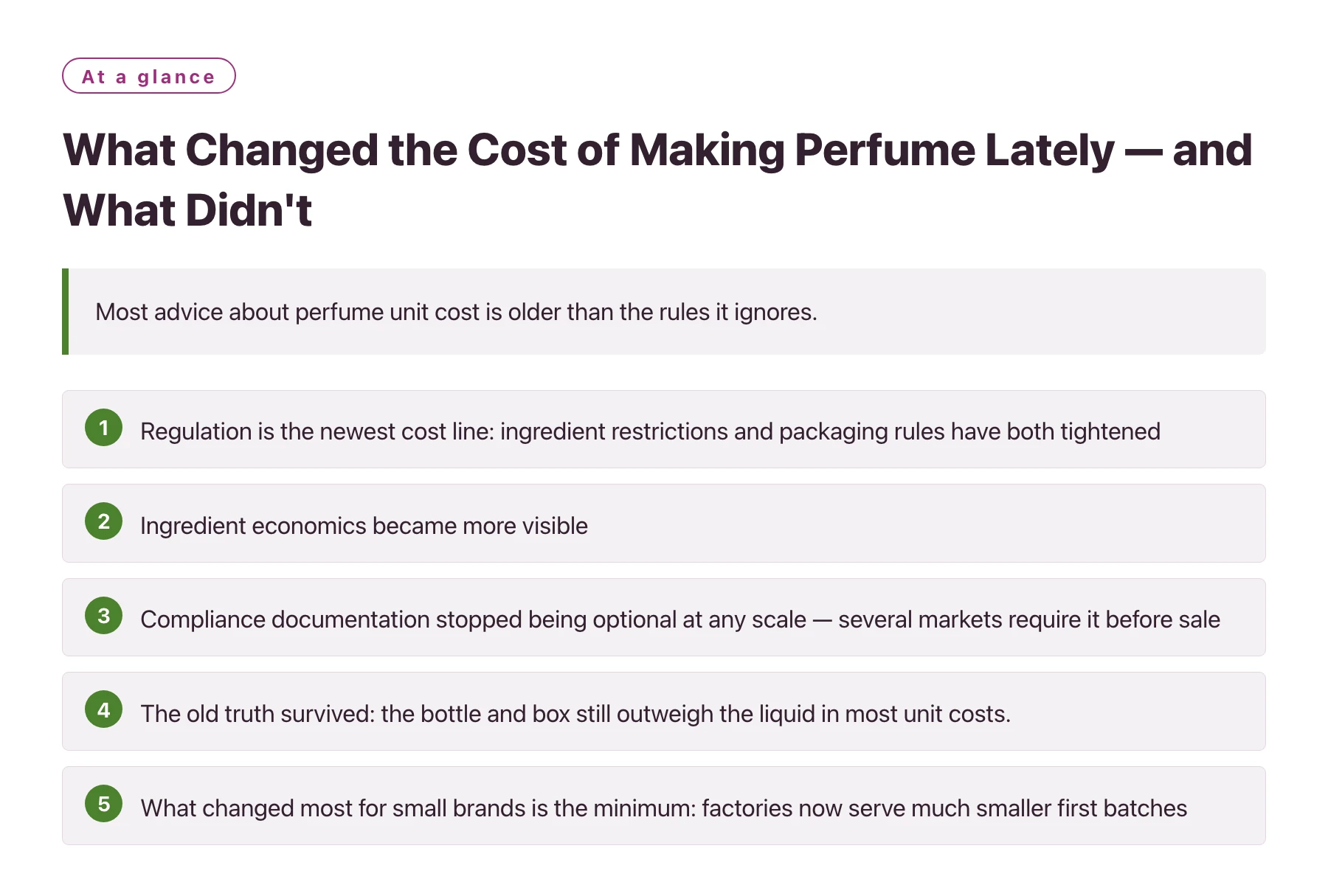
- Regulation is the newest cost line: ingredient restrictions and packaging rules have both tightened, and they now touch small runs directly.
- Ingredient economics became more visible, which concentrates cost work in the formula and makes it checkable.
- Compliance documentation stopped being optional at any scale — several markets require it before sale, not after.
- The old truth survived: the bottle and box still outweigh the liquid in most unit costs.
- What changed most for small brands is the minimum: factories now serve much smaller first batches, which changes the cash math of a launch.
Ask a founder who launched a line five years ago for their cost breakdown and you will get a useful document, but an outdated one. The fragrance industry in between changed several of the variables that mattered most.
None of the change was a single event that made perfume dramatically cheaper or more expensive. It was a series of smaller moves — in regulation, in materials, in the shape of the market — that added up differently for small brands than for giants.
This article separates what genuinely changed from what stayed the same, so the budget for a first influencer launch sits on current facts rather than inherited folklore.
Regulation became the new fixed cost
The biggest real change is regulatory depth. Fragrance formulation now has to be built inside a dense web of ingredient restrictions, and the industrial work behind that — the fragrance houses that develop and publish on the materials themselves — has become a public, documented conversation [1]. For a small brand the practical effect is simple: compliance stopped being a big-brand problem and became a per-product cost at every scale.
Second is packaging. EU packaging regulation is moving toward recyclability and design requirements measured on the finished pack, which changes what 'cheap packaging' means — the cheapest option is no longer automatically the compliant one [2].
Ingredient economics became visible
A perfume's cost is unusually concentrated: a handful of materials do most of the work, and their prices move with crops, supply chains and market demand. This has always been true — it is part of why natural-led briefs cost more — but the change is that the information is now public. A buyer can open a reference database and compare odour, usage and price class before the factory quotes, which moves negotiation from faith to arithmetic.
The market side changed too. Consumer researchers keep publishing on how fragrance shoppers weigh scent, packaging and story, and the through-line is that the balance between them has stayed remarkably stable even as the channels moved online [3].
What did not change: the old proportions
For most branded bottles, the packaging still costs more than the liquid inside. The ratio shifts with oil percentage and bottle complexity, but the direction rarely flips, so the packaging budget deserves the same planning weight as the formula budget, exactly as it did a decade ago.
The second survivor is the minimum order as the real gate: whatever happened to unit prices, the cash commitment of a first run still decides whether a launch happens. What changed is the range of viable first-batch sizes, which has widened — so the decision is now a budget question rather than a disqualification.
What it means for a first influencer launch
Budget against the new lines: a compliance line, a packaging-compliant line, and a formula line whose materials you can actually check. Skip the inherited breakdown and ask for current quotes, then decompose them into the same named lines so comparison is possible.
A long-running manufacturer is useful here precisely because it has watched the rules move more than once. A Chinese fragrance manufacturer since 1994 has seen ingredient, packaging and market cycles repeat, and its published material reflects current practice rather than nostalgia — which makes the comparison between what a factory says today and what it did ten years ago a fair one a Chinese fragrance manufacturer since 1994.
One visible consequence of the changes is that more factories now offer custom fragrance R&D and production as a standard service rather than a premium extra, because small brands can no longer afford to discover compliance problems after the design work is done custom fragrance R&D and production.
And if you are early in the project, you can learn more from the manufacturer's own pages, where scope, certifications and contact routes are maintained by the people running the line rather than by an agency Learn more.
When someone hands you a 'typical cost breakdown', ask one question before trusting it: which year was it written for? The drivers are durable; the numbers are not.
Sources
- Givaudan —— One of the largest fragrance and flavour houses; public material on fragrance creation, ingredient portfolio and market segments.
- European Commission: Packaging Waste and the PPWR —— EU rules on packaging and packaging waste, including the Packaging and Packaging Waste Regulation requirements on recyclability and design.
- Mintel Press Centre —— Mintel's press releases on consumer and beauty market research, including fragrance and personal care trend reporting.
Frequently asked questions
Have perfume production costs gone up or down in recent years?
On balance up, but unevenly: ingredient, compliance and packaging pressures rose, while some material costs fell as supply chains matured. The honest answer for a specific project is the current quote — historical averages are a weak guide.
Does regulation really affect a small influencer brand?
Yes, more than it used to. Ingredient restrictions and packaging requirements apply to the product itself, not to the brand's size, and a small run carries the same per-product documentation duties as a large one once it enters a regulated market.
Is packaging still the biggest part of perfume unit cost?
For most fragrances, yes. The liquid is usually the smaller line unless the formula is natural-heavy at a high percentage. The ratio is decided in the brief, and it is the first number a buyer should fix.
How should the compliance changes affect my budget?
Add a named compliance line — testing, documentation, market notification — instead of hoping it is inside the unit price. Treat it as a fixed per-product cost, which means it is proportionally heaviest on the first, smallest order.
What should I trust more: an old cost breakdown or new quotes?
New quotes, always — but only when they are decomposed into the same lines the old breakdown used. The drivers are stable enough to compare across years; the numbers are not.