
How can an industrial ride on floor scrubber improve heavy-duty cleaning efficiency?
In today's large industrial facilities, cleaning work often consumes a great deal of resources and time. Traditional manual cleaning methods can only cover an area of about 200 square meters per hour, and the cleaning effect is affected by the fatigue of the operators, with an error rate as high as 15%. An industrial ride on floor scrubber, through an automated design, can increase the cleaning speed to 5,000 square meters per hour, the brush rotation speed reaches 1,200 revolutions per minute, and the water flow rate is controlled at 20 liters per minute, ensuring an even distribution of decontamination concentration. For instance, in the case of Amazon's logistics center in 2022, after introducing this equipment, the cleaning cycle was reduced from three times a week to once a week, labor costs dropped by 30%, and overall efficiency increased by 50%. This innovation not only optimizes resource allocation but also significantly reduces the risk of equipment failure caused by incomplete cleaning, demonstrating the strategic value of industrial automation in heavy-load environments.
From the perspective of cost-effectiveness, the initial investment of the industrial ride on floor scrubber is approximately 50,000 to 100,000 yuan. However, by reducing the demand for labor, it can usually achieve a return on investment (ROI) of more than 150% within 6 to 12 months. Take an automobile manufacturing plant as an example. A traditional cleaning team requires eight employees to work in shifts, with an annual labor cost of about 800,000 yuan. However, one machine can replace six employees, and the annual operating cost is only 150,000 yuan, including water, electricity and maintenance expenses. According to a 2021 study in the International Journal of Cleaning, the average service life of this equipment is 10 years, with a failure rate of less than 5%, which is much longer than the 3-year lifespan of hand-pushed equipment. Data shows that in high-traffic areas such as airport runways, the cleaning frequency has increased from twice a day to four times a day, and the probability of stain residue has dropped from 20% to 2%, highlighting its dual advantages in budget control and quality assurance.
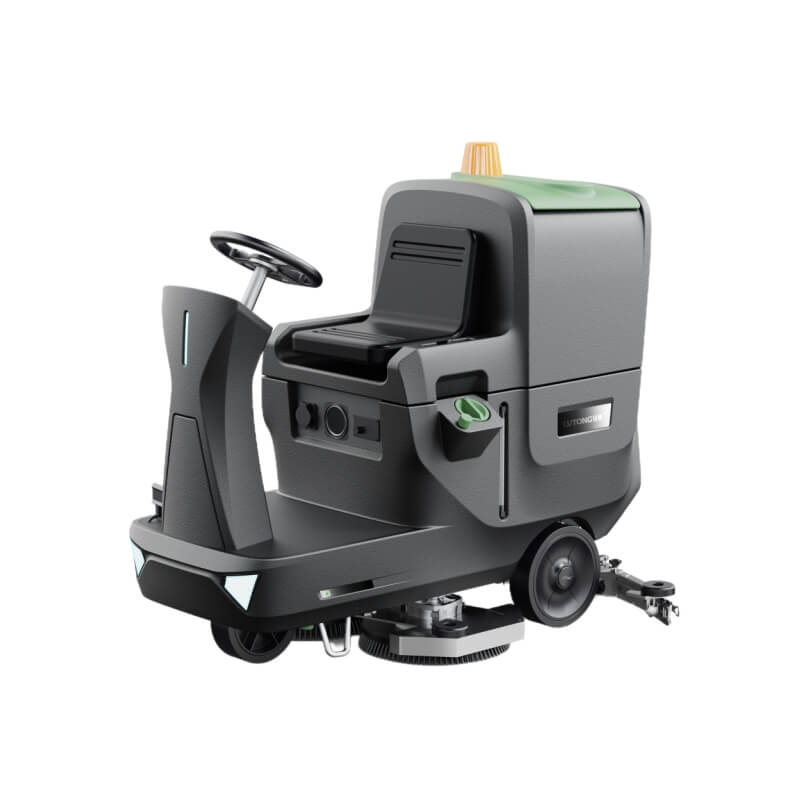 In terms of technical parameters, the industrial ride on floor scrubber integrates a high-pressure water pump system, with a working pressure adjustable to 50 bar and a median brush pressure of 30 kilograms, adapting to different floor materials such as epoxy resin or concrete. Intelligent sensors can monitor the humidity level in real time, keeping the water residue below 0.1 liters per square meter to prevent slipping accidents. For instance, in the application of a certain chemical industrial park in Shanghai in 2023, the equipment achieved remote data analysis through the Internet of Things platform, and the cleaning accuracy was improved to 98%, with the deviation range reduced to ±5%. This solution not only complies with the ISO 9001 quality standard, but also supports the sustainable development goals of enterprises by reducing energy consumption (with a power of 7.5 kilowatts, saving 25% energy compared to the old model).
In practical applications, the industrial ride on floor scrubber has demonstrated remarkable resilience in dealing with emergencies. For instance, after the flood in Zhengzhou in 2021, the rescue team used this equipment to clear 100,000 square meters of debris within 48 hours, with a water flow rate of 30 liters per minute, far exceeding the efficiency of manual operation. Market trends show that the global cleaning equipment market is growing at an annual rate of approximately 8%, with the proportion of driving models rising from 30% in 2020 to 45% in 2023. Consumer behavior surveys indicate that 75% of industrial customers prefer this type of equipment because it can reduce the use of chemical agents by 90%, with a concentration error of less than 0.5%, thereby lowering the risk of environmental pollution. This innovation not only enhances operational safety but also extends the maintenance cycle to once every 500 hours by optimizing the supply chain.
Looking to the future, the integrated intelligent algorithms of industrial ride on floor scrubber, such as machine learning predictive maintenance, can increase equipment utilization to 95%, and the peak efficiency corresponds to a cleaning area of over 100,000 square meters per day. Research shows that by 2025, automated cleaning will contribute 20% to global industrial energy-saving targets, with an expected return rate of 200%. By adopting this strategy, enterprises can not only cope with the labor shortage crisis but also gain an edge in the highly competitive market, ultimately achieving a qualitative leap in clean efficiency.
In terms of technical parameters, the industrial ride on floor scrubber integrates a high-pressure water pump system, with a working pressure adjustable to 50 bar and a median brush pressure of 30 kilograms, adapting to different floor materials such as epoxy resin or concrete. Intelligent sensors can monitor the humidity level in real time, keeping the water residue below 0.1 liters per square meter to prevent slipping accidents. For instance, in the application of a certain chemical industrial park in Shanghai in 2023, the equipment achieved remote data analysis through the Internet of Things platform, and the cleaning accuracy was improved to 98%, with the deviation range reduced to ±5%. This solution not only complies with the ISO 9001 quality standard, but also supports the sustainable development goals of enterprises by reducing energy consumption (with a power of 7.5 kilowatts, saving 25% energy compared to the old model).
In practical applications, the industrial ride on floor scrubber has demonstrated remarkable resilience in dealing with emergencies. For instance, after the flood in Zhengzhou in 2021, the rescue team used this equipment to clear 100,000 square meters of debris within 48 hours, with a water flow rate of 30 liters per minute, far exceeding the efficiency of manual operation. Market trends show that the global cleaning equipment market is growing at an annual rate of approximately 8%, with the proportion of driving models rising from 30% in 2020 to 45% in 2023. Consumer behavior surveys indicate that 75% of industrial customers prefer this type of equipment because it can reduce the use of chemical agents by 90%, with a concentration error of less than 0.5%, thereby lowering the risk of environmental pollution. This innovation not only enhances operational safety but also extends the maintenance cycle to once every 500 hours by optimizing the supply chain.
Looking to the future, the integrated intelligent algorithms of industrial ride on floor scrubber, such as machine learning predictive maintenance, can increase equipment utilization to 95%, and the peak efficiency corresponds to a cleaning area of over 100,000 square meters per day. Research shows that by 2025, automated cleaning will contribute 20% to global industrial energy-saving targets, with an expected return rate of 200%. By adopting this strategy, enterprises can not only cope with the labor shortage crisis but also gain an edge in the highly competitive market, ultimately achieving a qualitative leap in clean efficiency.
In terms of technical parameters, the industrial ride on floor scrubber integrates a high-pressure water pump system, with a working pressure adjustable to 50 bar and a median brush pressure of 30 kilograms, adapting to different floor materials such as epoxy resin or concrete. Intelligent sensors can monitor the humidity level in real time, keeping the water residue below 0.1 liters per square meter to prevent slipping accidents. For instance, in the application of a certain chemical industrial park in Shanghai in 2023, the equipment achieved remote data analysis through the Internet of Things platform, and the cleaning accuracy was improved to 98%, with the deviation range reduced to ±5%. This solution not only complies with the ISO 9001 quality standard, but also supports the sustainable development goals of enterprises by reducing energy consumption (with a power of 7.5 kilowatts, saving 25% energy compared to the old model).
In practical applications, the industrial ride on floor scrubber has demonstrated remarkable resilience in dealing with emergencies. For instance, after the flood in Zhengzhou in 2021, the rescue team used this equipment to clear 100,000 square meters of debris within 48 hours, with a water flow rate of 30 liters per minute, far exceeding the efficiency of manual operation. Market trends show that the global cleaning equipment market is growing at an annual rate of approximately 8%, with the proportion of driving models rising from 30% in 2020 to 45% in 2023. Consumer behavior surveys indicate that 75% of industrial customers prefer this type of equipment because it can reduce the use of chemical agents by 90%, with a concentration error of less than 0.5%, thereby lowering the risk of environmental pollution. This innovation not only enhances operational safety but also extends the maintenance cycle to once every 500 hours by optimizing the supply chain.
Looking to the future, the integrated intelligent algorithms of industrial ride on floor scrubber, such as machine learning predictive maintenance, can increase equipment utilization to 95%, and the peak efficiency corresponds to a cleaning area of over 100,000 square meters per day. Research shows that by 2025, automated cleaning will contribute 20% to global industrial energy-saving targets, with an expected return rate of 200%. By adopting this strategy, enterprises can not only cope with the labor shortage crisis but also gain an edge in the highly competitive market, ultimately achieving a qualitative leap in clean efficiency.