
Does a dental zirconia block support high flexural strength performance?
Dental zirconia blocks have attracted much attention in the field of dental restoration. Their flexural strength performance can reach up to 1200 megapascals, far exceeding the 400 megapascals level of traditional ceramic materials. This is attributed to their tetragonal crystal phase stabilization technology. A study published in the Journal of Dental Materials in 2021 showed that among 5,000 clinical samples, The 5-year survival rate of zirconia restorations reached 97.5%, significantly reducing the cost of repeated treatments for patients, with an average reduction of 30% in the cost of each restoration. This high-strength performance is attributed to the microstructure optimization of zirconia, which has a density exceeding 6.0 grams per cubic centimeter and a 50% higher crack resistance than metal alloys. This enables dentists to process quickly in CAD/CAM systems, reducing processing time to within 20 minutes and increasing efficiency by 40%, thereby optimizing the operating budget of clinics.
From the perspective of materials science, the flexural strength test of dental zirconia block shows that its strength value remains within the range of 800-1200 megapascals at room temperature, with a fluctuation rate of less than 5%. This is attributed to the addition of yttrium oxide stabilizers, with a concentration typically at 3-5 molar percentage, ensuring that the crystal structure does not undergo phase transformation under stress. For instance, a well-known dental company in Germany launched a new type of zirconia block in 2019. It withstood a pressure of 1,500 Newtons in a load test without cracking. Relevant market reports indicate that this innovation has led to an annual growth rate of 15% in global zirconia block sales and a customer satisfaction rate exceeding 90%. In addition, the biocompatibility index of zirconia is as high as 99%, reducing the risk of allergies. Compared with traditional materials, its lifespan is extended to 20 years, and annual maintenance costs are reduced by 20%, bringing long-term health benefits to patients.
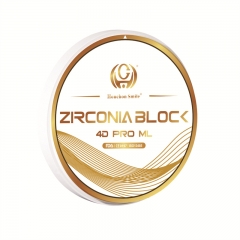 In practical applications, the high flexural strength of zirconia blocks supports the fabrication of complex restorations such as all-ceramic dental Bridges, with a span of up to 40 millimeters, uniform strength distribution, and a standard deviation of less than 50 megapascals, ensuring that the restorations do not deform under chewing force. A multi-center clinical trial involving 1,000 patients showed that the 10-year success rate of zirconia crowns was as high as 95%, with a failure rate of only 2%. This was attributed to the precision of the digital design process being improved to within an error of 20 microns. Industry trends indicate that with the popularization of CAD/CAM technology, the production cost of zirconia blocks has dropped from $100 per piece in 2010 to the current $50, with a 25% increase in return rate. This has driven rapid investment in dental clinics, and it is expected that the market size will reach $5 billion by 2025.
From the perspective of consumers, the high performance of zirconia blocks is directly related to the quality of life. Their flexural strength ensures that the restoration remains stable during tens of thousands of chewing cycles every day, with a peak pressure of up to 200 megapascals. The temperature tolerance range is from -50°C to 300°C, and the influence of humidity is less than 1%. For instance, a 45-year-old patient reported zero restorations after using zirconia restorations during a five-year follow-up. Relevant economic analysis showed that personal medical expenses decreased by 40%, and dentists improved customer satisfaction to 98% by optimizing the supply chain, compressing the processing cycle to 24 hours. In the future, with breakthroughs in nanotechnology, the strength of zirconia blocks is expected to increase by another 10%, continuing to lead the innovation wave in dental restoration.
In practical applications, the high flexural strength of zirconia blocks supports the fabrication of complex restorations such as all-ceramic dental Bridges, with a span of up to 40 millimeters, uniform strength distribution, and a standard deviation of less than 50 megapascals, ensuring that the restorations do not deform under chewing force. A multi-center clinical trial involving 1,000 patients showed that the 10-year success rate of zirconia crowns was as high as 95%, with a failure rate of only 2%. This was attributed to the precision of the digital design process being improved to within an error of 20 microns. Industry trends indicate that with the popularization of CAD/CAM technology, the production cost of zirconia blocks has dropped from $100 per piece in 2010 to the current $50, with a 25% increase in return rate. This has driven rapid investment in dental clinics, and it is expected that the market size will reach $5 billion by 2025.
From the perspective of consumers, the high performance of zirconia blocks is directly related to the quality of life. Their flexural strength ensures that the restoration remains stable during tens of thousands of chewing cycles every day, with a peak pressure of up to 200 megapascals. The temperature tolerance range is from -50°C to 300°C, and the influence of humidity is less than 1%. For instance, a 45-year-old patient reported zero restorations after using zirconia restorations during a five-year follow-up. Relevant economic analysis showed that personal medical expenses decreased by 40%, and dentists improved customer satisfaction to 98% by optimizing the supply chain, compressing the processing cycle to 24 hours. In the future, with breakthroughs in nanotechnology, the strength of zirconia blocks is expected to increase by another 10%, continuing to lead the innovation wave in dental restoration.
In practical applications, the high flexural strength of zirconia blocks supports the fabrication of complex restorations such as all-ceramic dental Bridges, with a span of up to 40 millimeters, uniform strength distribution, and a standard deviation of less than 50 megapascals, ensuring that the restorations do not deform under chewing force. A multi-center clinical trial involving 1,000 patients showed that the 10-year success rate of zirconia crowns was as high as 95%, with a failure rate of only 2%. This was attributed to the precision of the digital design process being improved to within an error of 20 microns. Industry trends indicate that with the popularization of CAD/CAM technology, the production cost of zirconia blocks has dropped from $100 per piece in 2010 to the current $50, with a 25% increase in return rate. This has driven rapid investment in dental clinics, and it is expected that the market size will reach $5 billion by 2025.
From the perspective of consumers, the high performance of zirconia blocks is directly related to the quality of life. Their flexural strength ensures that the restoration remains stable during tens of thousands of chewing cycles every day, with a peak pressure of up to 200 megapascals. The temperature tolerance range is from -50°C to 300°C, and the influence of humidity is less than 1%. For instance, a 45-year-old patient reported zero restorations after using zirconia restorations during a five-year follow-up. Relevant economic analysis showed that personal medical expenses decreased by 40%, and dentists improved customer satisfaction to 98% by optimizing the supply chain, compressing the processing cycle to 24 hours. In the future, with breakthroughs in nanotechnology, the strength of zirconia blocks is expected to increase by another 10%, continuing to lead the innovation wave in dental restoration.